.svg)


Signs Your AC Compressor is Failing: A Troubleshooting Guide for Homeowners
Is your AC compressor failing after a brutal summer? Review clear options comparisons for homeowners and decide with confidence on your next steps this fall.


That harsh buzzing sound from your backyard followed by warm air from the vents often leads to a stressful scenario: facing The Condemned AC Unit: Reversing Premature Replacement Recommendations after a technician declares your system completely dead. At Klee's Climate Control LLC, we know that the panic of a sudden system failure is especially intense during the September transition, right at the end of the summer cooling season when reliable air conditioning is still heavily relied upon to keep your home habitable before the cooler fall weather arrives. You expect a routine service call, but instead, a technician quickly condemns the unit, stating the compressor has failed catastrophically.
This puts you at a critical decision point. You must choose between accepting a massive replacement quote under extreme pressure or pausing to seek a secondary diagnostic. In our years of serving Mesa, we've found that many systems labeled as "dead" actually suffer from minor, highly correctable electrical faults. Before making a major financial commitment, it is essential to understand the mechanics of your cooling system. Exploring professional Air Conditioning Services can provide the clarity needed to separate a true mechanical failure from a simple, inexpensive electrical issue.
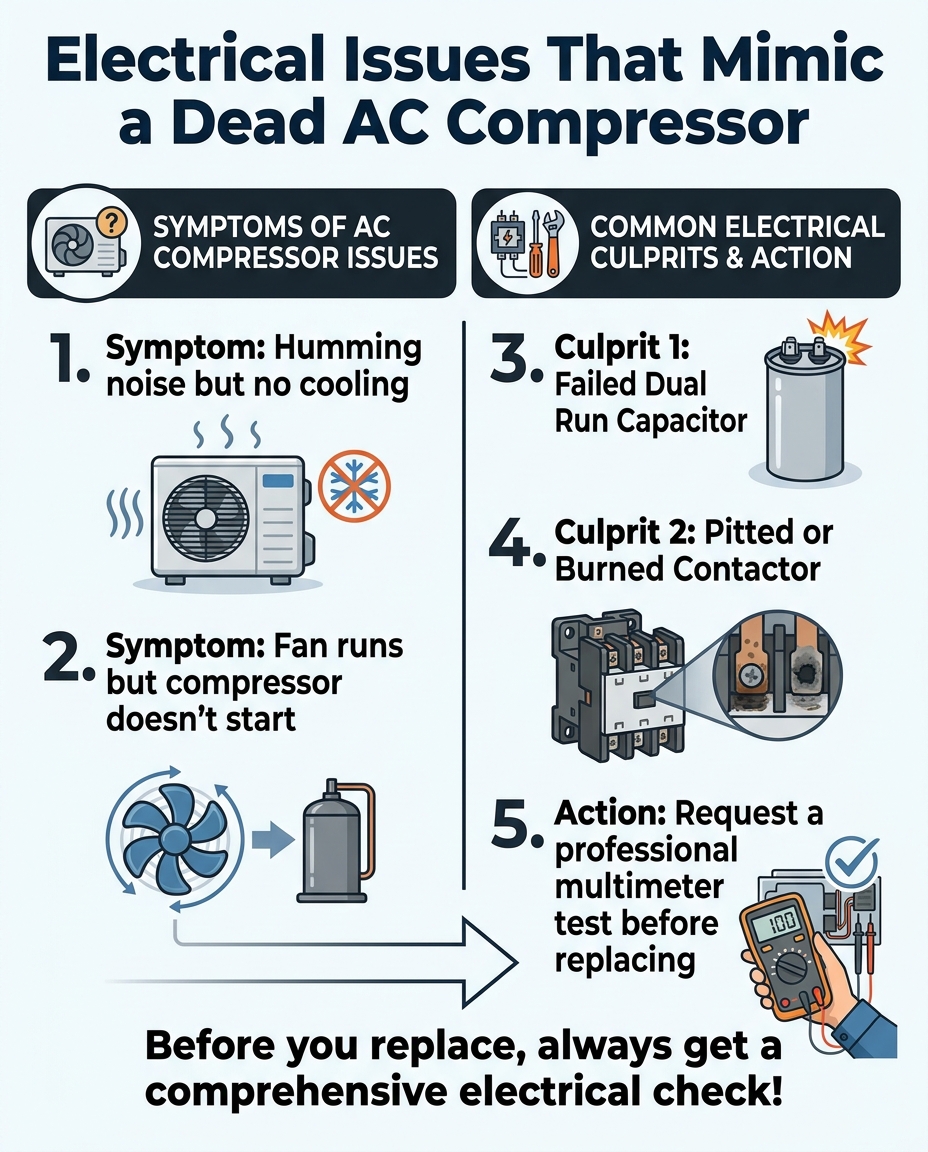
When an air conditioner fails to start, the symptoms homeowners observe are usually alarming. You might notice the indoor fan running but absolutely no cooling taking place, loud humming or buzzing noises coming from the outdoor condensing unit, or the system attempting a "hard start" where it shudders and immediately shuts down. These exact symptoms are shared by both catastrophic mechanical failure—such as a physically seized compressor—and simple electrical faults. Because the outward signs are identical, our team frequently sees how the urgency of a breakdown can easily lead to rushed diagnostics by inexperienced or sales-driven technicians.
Without thorough electrical testing, a compressor cannot be ethically condemned. A comprehensive evaluation isolates the electrical components from the heavy mechanical parts. If a technician simply listens to the unit hum and declares the compressor dead without using a multimeter to test the electrical supply, the diagnosis is incomplete. Understanding these overlapping symptoms is a critical part of preventing and fixing AC compressor problems before you authorize a full system replacement.
To better understand why misdiagnoses happen so frequently, it helps to see how mechanical and electrical failures mimic one another. Below is a breakdown of common symptoms and their potential causes that we typically encounter in the field.
• Loud humming but no startup — Potential Mechanical Cause: Seized compressor bearings — Potential Electrical Cause: Failed dual run capacitor
• Intermittent starting and stopping — Potential Mechanical Cause: Internal thermal overload tripping — Potential Electrical Cause: Pitted or burned contactor
• System completely unresponsive — Potential Mechanical Cause: Broken internal mechanical linkage — Potential Electrical Cause: Tripped high-voltage breaker or blown fuse
• Fan runs, compressor silent — Potential Mechanical Cause: Broken compressor valves — Potential Electrical Cause: Loose wiring at the contactor block
The critical takeaway: A non-starting compressor does not automatically mean a broken compressor. The mechanical heart of your system relies entirely on external electrical components to function.
According to Department of Energy (DOE) data—and backed by what our team at Klee's Climate Control LLC sees every day—electrical control failure is one of the most common causes of air conditioning system breakdowns. When an outdoor unit fails to engage, the true culprits are usually the small electrical devices housed within the condenser's access panel. A failed capacitor or a pitted contactor completely prevents the compressor from engaging, creating the perfect illusion of a dead unit.
The dual run capacitor is arguably the hardest-working electrical component in your outdoor unit. It serves a vital function that the compressor cannot perform on its own.
• Acting as a battery: The compressor motor requires a massive, immediate jolt of energy to overcome inertia and start spinning. The capacitor stores this energy and delivers it in a fraction of a second.
• Maintaining the spin: Once the compressor is running, the capacitor continues to provide a steady, regulated electrical current to keep the motor spinning smoothly.
• The humming symptom: If the capacitor loses its ability to store a charge, it cannot deliver that initial jolt. The compressor tries to start, fails, and emits a loud humming sound as electrical current dead-ends at the motor.
The contactor is the heavy-duty electrical switch that powers the outdoor condensing unit. When your indoor thermostat calls for cooling, it sends a low-voltage signal to the contactor, pulling a magnetic coil closed to bridge the high-voltage power to the compressor and fan.
• Bridging high-voltage power: The contactor is the literal gatekeeper of electricity for your outdoor unit. If it fails, no power reaches the compressor.
• Electrical arcing degradation: Every time the contactor closes, a small electrical arc occurs. Over thousands of cycles, this arcing causes the metal contact pads to become pitted, burned, and covered in carbon buildup.
• The silent failure: If the contactor is heavily pitted, the low-voltage signal may pull the switch closed, but the high-voltage electricity cannot pass through the carbon buildup, leaving the compressor completely silent and seemingly dead.

The environment your outdoor unit operates in plays a massive role in the lifespan of its electrical components. With Mesa's 110+ degree summer heat specifically degrading electrical components inside the outdoor condensing unit faster than the compressor's internal mechanics, the risk of misdiagnosis peaks late in the year. By the September transition, as we start scheduling pre-heating-season tune-ups, your system has endured thousands of hours of continuous high-load operation. This compounding stress pushes electrical components to their absolute limits.
The impact of thermal degradation: Electrolytic capacitors are highly susceptible to bulging and failure due to thermal degradation. Inside a capacitor is a liquid electrolyte that helps store the electrical charge. When the ambient temperature outside exceeds 110 degrees, and the internal operating temperature of the condenser adds even more heat, this liquid begins to bake. Over a long, brutal summer, the fluid expands, causing the top of the capacitor to bulge outward and eventually fail completely.
ASHRAE guidelines and ambient heat: Guidelines from the American Society of Heating, Refrigerating and Air-Conditioning Engineers (ASHRAE) highlight the severe ambient heat stress placed on outdoor condensing units in extreme climates. The compressor's heavy internal steel mechanics are often perfectly fine and capable of running for years to come. It is the sensitive electrical enclosure, baking in the direct sun, that fails first. When these components give out under the immense heat, securing professional AC repair in Mesa to replace a swollen capacitor can instantly bring a "dead" system back to life.
Losing air conditioning during a severe heatwave causes immense physical and emotional stress. When the house is rapidly heating up and your family is uncomfortable, you are naturally in a vulnerable state. This vulnerability makes homeowners highly susceptible to high-pressure sales tactics. Some companies take advantage of this desperation, pushing full system replacements instead of performing detailed electrical diagnostics.
The rush to replace: When a technician arrives at a sweltering house, sees an older unit, and hears a humming compressor, it is much faster and more profitable for them to condemn the unit than to spend time testing individual circuits. They may present a massive replacement quote, leveraging the severe heat to force an immediate decision. However, pausing to verify the diagnosis is the most financially protective step a homeowner can take.
A pattern of reliable second opinions: The value of an honest secondary evaluation cannot be overstated. Our team at Klee's Climate Control LLC recently helped a local Mesa homeowner who experienced a complete system failure right as the late-summer heat lingered. After reaching out to us for a second look, we dispatched a technician who accurately diagnosed a pitted contactor instead of a failed compressor, and we had their AC back working within an hour of our arrival. This scenario perfectly illustrates that a non-working system often requires a targeted fix rather than total replacement. If you are ever pressured into an immediate overhaul, seeking trustworthy HVAC replacement services for a second opinion is always the smartest move.
A commitment to honest diagnostics and integrity means providing trustworthy second opinions that fix simple faults instead of pushing unnecessary replacements. When you request a professional evaluation from Klee's Climate Control LLC, you should expect our technicians to follow a rigorous, step-by-step process to isolate the true cause of the failure.
1. Visual Inspection: Our technician will first inspect the outdoor unit for obvious signs of damage, such as a bulging capacitor, burned wires, or a heavily pitted contactor block.
2. Electrical Isolation: A proper diagnostic isolates the electrical components from the mechanical components. We will disconnect the power to test the electrical supply independently of the compressor motor.
3. Capacitance Testing: Using a specialized multimeter, our technician will measure the microfarads (the unit of capacitance) of the dual run capacitor to ensure it is delivering the correct starting jolt.
4. Voltage Drop Testing: We will check the contactor to ensure that high-voltage electricity is successfully passing through the switch when the thermostat calls for cooling.
5. Winding Checks: Only after verifying the electrical supply will our high-integrity technicians test the compressor's internal electrical windings to see if they are shorted to ground or open.
A strict warning regarding high-voltage testing: Homeowners must never attempt to perform these diagnostics themselves. The outdoor condensing unit contains high-voltage electricity and capacitors that store lethal charges even when the power is turned off. These diagnostics must be performed exclusively by licensed professionals.
To ensure you are receiving a thorough evaluation, empower yourself with the right diagnostic vocabulary. Ask these specific questions:
• Did you test the dual run capacitor? Ask for the specific microfarad reading compared to the manufacturer's rating.
• Is the contactor pulling in correctly? Ask if there is a voltage drop across the contactor pads indicating carbon buildup.
• Are the compressor windings shorted to ground? This is the definitive test for a truly dead compressor motor.
Yes, a bad capacitor perfectly mimics a bad compressor. The capacitor acts as a battery that provides the initial surge of energy needed to start the compressor motor. If the capacitor fails, the motor cannot overcome its own inertia, resulting in a loud humming noise and a failure to start, which looks exactly like a seized compressor.
The only way to know if an AC compressor is truly dead is through comprehensive electrical testing by a licensed professional. A technician must use a multimeter to verify that the compressor's internal electrical windings are either shorted to ground or completely open. Visual or auditory symptoms alone are never enough to definitively condemn the unit.
An AC compressor usually stops working suddenly due to an electrical supply failure rather than a mechanical breakdown. A tripped breaker, a blown disconnect fuse, a failed contactor, or a dead dual run capacitor will instantly cut power to the compressor. While internal mechanical failures do happen, electrical faults are vastly more common.
When an AC contactor goes bad, it fails to bridge the high-voltage electricity from your home's electrical panel to the outdoor condensing unit. The contact pads can become pitted and covered in carbon from repeated electrical arcing over time. When this happens, the switch may physically close, but the electricity cannot pass through, leaving the compressor without power.
If your indoor AC fan is running but the outdoor compressor is not turning on, the issue is typically isolated to the outdoor unit's electrical enclosure. The indoor air handler operates on a separate circuit. A failed dual run capacitor or a broken wire at the outdoor contactor will prevent the compressor from engaging while the indoor fan continues to circulate uncooled air.
Extreme ambient heat accelerates the thermal degradation of sensitive electrical components inside the condenser. Electrolytic capacitors contain fluid that expands and bakes when exposed to prolonged temperatures over 110 degrees, eventually causing the component to swell and fail. This cumulative heat stress is why electrical breakdowns spike at the end of the summer season.
The most important lesson for any homeowner is that a non-starting air conditioner does not automatically mean a dead compressor. The outward symptoms of catastrophic mechanical failure and minor electrical faults are virtually identical. Because extreme heat continuously degrades components like capacitors and contactors, these inexpensive parts are frequently the true cause of a sudden breakdown.
If you find yourself facing a massive replacement quote, remember the value of a professional second opinion from Klee's Climate Control LLC, especially in the Mesa AZ area where heat stress is a constant factor. Do not let the pressure of a hot house force you into an unnecessary financial burden. By understanding the basics of electrical diagnostics and asking the right questions, you can confidently navigate The Condemned AC Unit: Reversing Premature Replacement Recommendations and ensure your cooling system receives the honest, thorough evaluation it deserves.
Hear what our Mesa, AZ. customers have to say about the comfort, reliability, and peace of mind they’ve experienced with Klee's Climate Control.

Chuck was fast, professional and very reasonable. He saved us about $1500 over another company's quote and we will be using him from now on.
Our Home Warranty company wouldn't even answer their phone, and none of the others were available until Monday.
He explained everything that needed to be done and helped us make a plan for when we eventually need to replace our older a/c unit.
He instructed me on texts and the problem is solved.

Chuck was fast, professional and very reasonable. He saved us about $1500 over another company's quote and we will be using him from now on.
Our Home Warranty company wouldn't even answer their phone, and none of the others were available until Monday.
He explained everything that needed to be done and helped us make a plan for when we eventually need to replace our older a/c unit.
He instructed me on texts and the problem is solved.