.svg)


Signs Your AC Compressor is Failing: A Troubleshooting Guide for Homeowners
Is your AC compressor failing after a brutal summer? Review clear options comparisons for homeowners and decide with confidence on your next steps this fall.


That strange noise from your condenser isn't going away on its own, and making accurate options comparisons for homeowners can feel overwhelming when you suspect a major equipment failure. After months of running nonstop to battle the summer heat, your cooling system has endured an incredible amount of stress. Here at Klee's Climate Control LLC, our team frequently sees the aftermath of this strain as we approach the fall transition and the October heating-startup period, when the wear and tear on your equipment becomes impossible to ignore. Identifying the early symptoms of mechanical fatigue can mean the difference between a simple tune-up and a complete system breakdown.
For expert guidance, explore our air conditioning services or schedule an AC repair in Mesa today.
The heart of your cooling system: At the center of your outdoor condensing unit sits the compressor. This heavy-duty motor is responsible for pumping refrigerant through the lines, making the entire heat-transfer process possible. When this component begins to fail, the entire system loses its ability to keep your home comfortable.
Catching problems early: In our experience, a failing compressor rarely dies without warning. It usually gives off auditory, electrical, or performance clues long before it completely locks up. Recognizing these signs allows you to make an informed decision about whether your system needs a minor component replacement or a major upgrade before the weather shifts entirely.
To understand why your system might be failing, it helps to know exactly what this critical component does. The compressor acts as the engine of your air conditioner. Its primary job is to take warm, low-pressure refrigerant gas from your indoor evaporator coil and squeeze it into a hot, high-pressure gas. This pressurized gas then travels through the outdoor condenser coils, where the fan blows outside air over it to release the heat.
The impact of regional weather: In our years of servicing HVAC systems across Mesa AZ, we've seen firsthand how this process is pushed to its absolute limits. With summer temperatures frequently exceeding 110 degrees, your system has to work incredibly hard to release heat into an already scorching environment. This extreme ambient heat forces the compressor to run in longer, continuous cycles just to maintain indoor comfort. Over time, this unique, continuous strain takes a significant toll on the internal motor windings and mechanical parts.
Environmental hazards: Beyond just the temperature, the desert environment introduces dust, dirt, and airborne debris. When this debris coats the outdoor condenser coils, it acts like a layer of insulation. The system can no longer release heat efficiently, which causes internal pressures to skyrocket. The compressor is then forced to work twice as hard to achieve the same level of cooling, accelerating the rate of wear and tear. If you want to dive deeper into how this environment affects your equipment, read more about why your AC struggles in 110-degree heat.
The Problem: You step outside and notice that your air conditioner sounds entirely different than it did a few months ago. Instead of a smooth, consistent hum, the unit is making loud, disruptive noises that can be heard from inside the house.
The Cause: Air conditioning compressors contain tightly machined internal parts, including pistons or scroll plates, valves, and a heavy-duty electrical motor. When these parts begin to wear out, break, or lose their internal lubrication, they create distinct mechanical sounds. In Mesa AZ, where our technicians see systems run for thousands of hours a season, this mechanical fatigue is a common precursor to total failure.
The Solution: If you hear severe grinding or metal-on-metal clanking, turn off your thermostat immediately. Running a system with broken internal components will contaminate the refrigerant lines with metal shavings, making future repairs much more difficult. Call a professional to evaluate the system before turning it back on.
Different noises point to different types of mechanical or electrical stress. Here is a pattern we see often when diagnosing systems:
• Clicking and stuttering: Often referred to as "hard starting," a loud clicking or stuttering sound when the unit tries to turn on usually points to electrical issues, failing relays, or a struggling motor that cannot overcome the starting pressure.
• Squealing or hissing: A high-pitched squeal can indicate a motor bearing failure. However, a loud screaming or hissing noise can also signal a dangerous internal pressure buildup, causing the compressor's internal relief valve to vent.
• Rattling or clanking: This typically indicates loose mounting hardware, a broken internal suspension spring, or internal components that have physically broken apart and are vibrating inside the sealed steel shell.
One of the most frustrating symptoms of a failing compressor is an air conditioner that runs constantly but fails to actually cool the house. You might feel air coming out of your vents, but it is lukewarm or barely cool. This is a major red flag as we approach the fall transition and October heating-startup, because a system that cannot cool effectively will also struggle to perform if you rely on a heat pump for winter warmth.
Loss of compression ratio: As a compressor ages, the internal valves and seals can wear down. When this happens, the motor is still running and consuming electricity, but it is no longer successfully compressing the refrigerant gas. Our crew at Klee's Climate Control LLC refers to this as a system that is "running but not pumping." Because the refrigerant isn't being pressurized properly, the heat transfer process stops, and your vents blow warm air.
Mimicking a refrigerant leak: It is important to note that a compressor that has lost its pumping ability mimics the exact symptoms of a system that is low on refrigerant. In both scenarios, the air is warm and the system runs endlessly. You cannot diagnose this by simply feeling the air or looking at the unit. A licensed technician must connect digital gauges to measure the operating pressures and perform a professional diagnostic to verify whether the issue is a lack of refrigerant or a failing compressor motor.
The Problem: Your air conditioner attempts to turn on, but it immediately trips the circuit breaker in your electrical panel, shutting down power to the entire unit.
The Cause: Circuit breakers are safety devices designed to protect your home's electrical wiring from overheating and causing a fire. As a compressor motor begins to fail, it encounters internal mechanical resistance. To overcome this resistance and keep spinning, the motor draws an excessive amount of electrical current (amps). If the insulation on the internal copper motor windings burns off due to extreme heat or acid buildup in the system, the electrical current can touch the metal casing. This is known as a compressor that is "shorted to ground." When the system draws too many amps or shorts to ground, the breaker trips instantly to prevent a catastrophe.
The Solution: Never repeatedly reset a tripping AC breaker. If the breaker trips more than once, leave it off. Forcing a grounded or locked-up compressor to repeatedly draw massive amounts of electricity can cause severe damage to your electrical panel or start a fire. One of our technicians in Mesa AZ will use a specialized multimeter to test the motor windings and confirm exactly how many amps the system is pulling, safely determining if the motor is grounded.
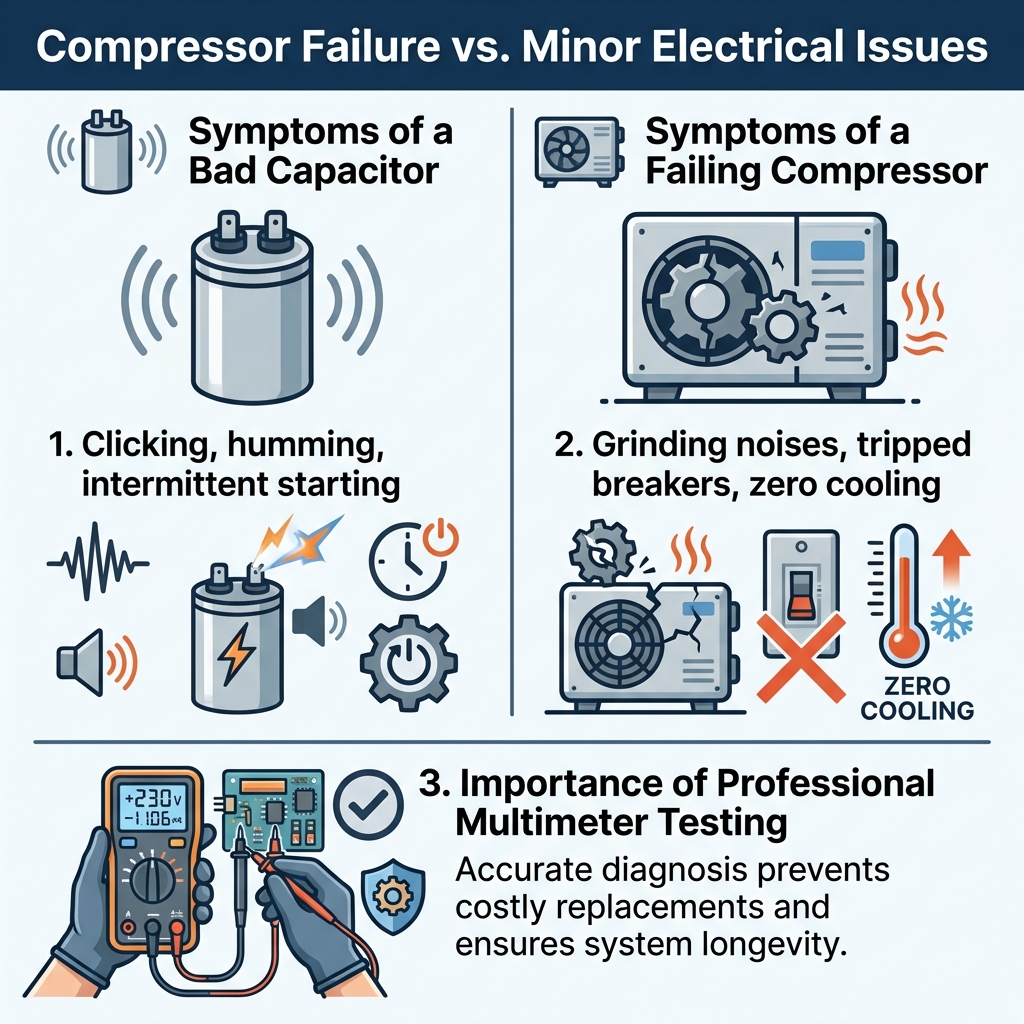
When your system is blowing warm air, making terrible noises, or tripping breakers, it is easy to assume the worst. However, our team at Klee's Climate Control LLC understands that not all scary symptoms mean a dead compressor. Our commitment to honest diagnostics ensures that we determine whether you are facing a simple electrical fix or a true mechanical failure, preventing premature and unnecessary replacements.
The role of the dual run capacitor: The most common culprit behind a system that sounds completely broken is a failed dual run capacitor. This small, affordable electrical component stores energy and provides the initial jolt of voltage needed to start the compressor. If the capacitor fails, the compressor will hum loudly, overheat, and shut down on its thermal overload switch. To a homeowner, this looks and sounds exactly like a dead system. A pitted or burned contactor (the switch that sends power to the outdoor unit) can cause the exact same symptoms.
Real-world reliability: One Mesa homeowner we recently served experienced a sudden AC issue right in the middle of a major heat wave. Because our technician responded quickly, arrived promptly, and performed a thorough electrical inspection rather than just guessing, the problem was correctly identified as a minor component failure. The AC system was repaired in a timely manner without the homeowner being pressured into a massive equipment swap.
The value of testing: In some cases, our technicians may install a "hard start kit" to safely extend the life of an aging compressor that is struggling to turn on. Never assume the entire unit needs replacement without a thorough multimeter and gauge test. If a technician immediately pushes for a full system replacement without checking the electrical components first, it is always worth getting a second opinion.

If professional testing confirms that the compressor has truly failed, you will face a critical decision: pay for a major repair, or replace the equipment entirely. When guiding customers through these choices, our team typically advises looking at the age of your system, its warranty status, and your long-term goals for home comfort in Mesa AZ.
Warranty considerations: If your system is relatively new (typically under 10 years old) and you are the original owner, the compressor is likely covered under a manufacturer's parts warranty. In this scenario, you only pay for the labor and refrigerant required to install the new part, making repair a highly cost-effective choice.
When replacement makes sense: If the system is out of warranty and over 10 to 12 years old, we recommend replacing the entire condensing unit or the whole system as the better long-term investment. Dropping a brand-new compressor into an old, deteriorating system is risky, as the other aging components (like the coils and fan motor) are likely nearing the end of their lifespans as well.
To help you weigh your choices, consider this breakdown we share with our local clients:
• Warranty Status — Major Repair (Compressor Only): Best if the part is still under manufacturer warranty. — Full System Replacement: Best if the system is out of warranty and repairs are costly.
• System Age — Major Repair (Compressor Only): Makes sense for systems under 8-10 years old. — Full System Replacement: Recommended for systems 10-12+ years old.
• Energy Efficiency — Major Repair (Compressor Only): Maintains the current, likely lower, efficiency rating. — Full System Replacement: Offers significantly higher energy efficiency and lower utility bills.
• Incentives — Major Repair (Compressor Only): Rarely eligible for rebates or credits. — Full System Replacement: Generic energy rebates or tax credits may apply to qualifying high-efficiency upgrades.
Upgrading to a new system also provides peace of mind, knowing that your equipment is ready to handle the demanding climate. If you are leaning toward an upgrade, learn more about the benefits of a professional AC replacement.
The best way to handle a compressor failure is to prevent it from happening in the first place. While all mechanical equipment eventually wears out, our maintenance crews know that proper upkeep dramatically reduces the overall workload on the system, extending its lifespan and keeping it running efficiently through the fall transition and October heating-startup.
Here are the most effective ways our team recommends to protect your equipment:
1. Maintain clear airflow outdoors: Keep the area around the outdoor condenser completely clear of vegetation, tall grass, branches, and debris. The system needs at least two feet of clearance on all sides to properly exhaust heat. If airflow is blocked, the compressor overheats.
2. Change indoor air filters regularly: A dirty, clogged air filter restricts airflow over the indoor evaporator coil. This can cause the indoor coil to freeze solid. When the coil freezes, the refrigerant doesn't absorb heat, and liquid refrigerant can travel back down the lines to the outdoor unit. Compressors are designed to pump gas, not liquid. Pumping liquid (known as "slugging") will destroy the compressor's internal valves instantly.
3. Keep the outdoor coils clean: Gently rinsing the outside of the condenser unit with a standard garden hose (never a pressure washer) can remove surface dust. However, deep cleaning requires professional chemical treatments to push dirt out from the inside.
4. Schedule professional seasonal tune-ups: The single most important step is having a licensed technician check the refrigerant charge and tighten electrical connections twice a year. An undercharged system starves the compressor of the cool refrigerant gas it relies on to keep its motor from overheating.
Staying proactive is the key to longevity. Secure your system's health by scheduling routine AC maintenance before the heavy weather hits.
The earliest signs include unusual noises like grinding or hard-starting clicks, a noticeable drop in cooling power, and the system struggling to turn on. You may also notice that your outdoor unit is vibrating excessively or that your circuit breaker trips occasionally when the system cycles on. Catching these early symptoms can prevent a total breakdown.
The compressor itself is a sealed, welded steel unit, meaning its internal mechanical parts cannot be repaired or rebuilt in the field. If the internal motor or valves fail, the entire compressor component must be replaced. However, if the issue is an external electrical part attached to the compressor, like a capacitor or relay, those can be easily and affordably swapped out.
In a demanding environment with extreme summer heat, a well-maintained compressor typically lasts between 10 and 15 years. The heavy workload and long running cycles naturally accelerate wear and tear. Systems that are neglected, run with dirty filters, or operate with improper refrigerant levels often fail much sooner.
A tripping breaker usually means the compressor is pulling too much electrical current due to mechanical resistance, or the motor windings have shorted to the metal casing. The breaker shuts off the power to prevent the wires from overheating and causing an electrical fire. You should never repeatedly reset a tripping AC breaker; call a professional for testing immediately.
Generally, replacing a compressor on a system that is 10 years old or older is not recommended unless the part is fully covered by a manufacturer warranty. At that age, the other major components in the system are also nearing the end of their useful lives. Investing in a new, highly efficient system is usually a smarter long-term financial decision.
Without professional tools, it is nearly impossible for a homeowner to tell the difference, as both issues cause the system to stop cooling and make humming or clicking noises. A licensed technician uses a digital multimeter to test the microfarad reading of the capacitor and the electrical resistance of the compressor's motor windings to provide an accurate diagnosis.
Dealing with an aging or struggling HVAC system can be stressful, but early detection of compressor issues saves you valuable time and prevents unexpected emergencies. What ultimately satisfies a homeowner is having a clear, technically sound understanding of their equipment's health, allowing them to make the best possible decisions for their property. By paying attention to strange noises, reduced cooling power, and electrical warning signs, you can stay ahead of major failures. As we move through the fall transition and approach the October heating-startup, now is the perfect time to seek professional, honest diagnostics. Let the experts at Klee's Climate Control LLC help you navigate the right options comparisons for homeowners, ensuring your system is efficient, reliable, and fully prepared for whatever the weather brings next.
Hear what our Mesa, AZ. customers have to say about the comfort, reliability, and peace of mind they’ve experienced with Klee's Climate Control.

Chuck was fast, professional and very reasonable. He saved us about $1500 over another company's quote and we will be using him from now on.
Our Home Warranty company wouldn't even answer their phone, and none of the others were available until Monday.
He explained everything that needed to be done and helped us make a plan for when we eventually need to replace our older a/c unit.
He instructed me on texts and the problem is solved.

Chuck was fast, professional and very reasonable. He saved us about $1500 over another company's quote and we will be using him from now on.
Our Home Warranty company wouldn't even answer their phone, and none of the others were available until Monday.
He explained everything that needed to be done and helped us make a plan for when we eventually need to replace our older a/c unit.
He instructed me on texts and the problem is solved.